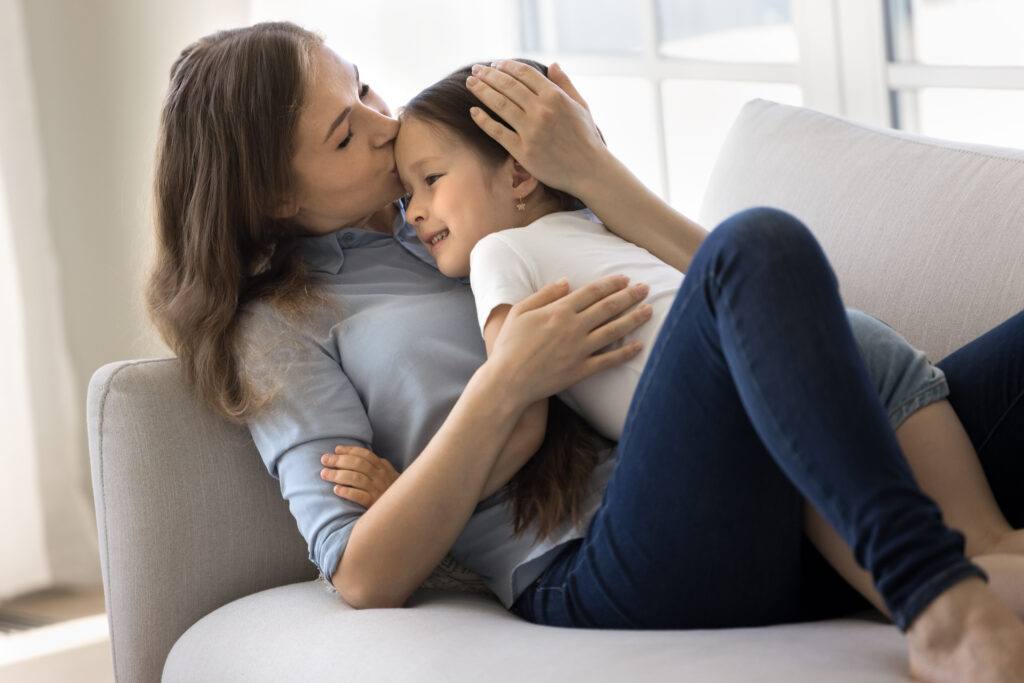
Kindness begins at home—with parents who lead by example. As author and researcher Stephen G. Post reminds us, small daily gestures of patience, empathy, and respect can shape a child’s lifelong capacity for love and compassion.
From the moment a child is born, their emotional world begins to take shape through connection and care. Before language or logic, infants feel love, safety, and acceptance—or, at times, fear and stress—through the emotions of those around them. These early experiences become the foundation for how they relate to others, perceive kindness, and express empathy later in life.
As parents, our words, tone, and daily habits model what love looks like in action. Creating a home environment rooted in kindness teaches children not only how to treat others but also how to understand themselves.
What Love Looks Like Through a Child’s Eyes
To remind us how deeply children understand kindness, researcher Sean Keener, a major voice in studying children’s capacity for empathy, once asked a group of kids, “What does love mean?”
Their answers were simple, yet profoundly moving:
“When my grandmother got arthritic, she couldn’t bend over and paint her toenails anymore. So, my grandfather does it for her all the time, even when his hands got arthritis too. That’s love.” — Rebecca, age 8
“When someone loves you, the way they say your name is different. You just know that your name is safe in their mouth.” — Billy, age 4
“Love is what’s in the room with you at Christmas if you stop opening presents and listen.” — Bobby, age 7
A six-year-old child saw an old man crying after losing his wife of many years. The boy went into the old man’s yard and sat down next to him. His mother asked him what he said to their neighbor. The boy answered, “Nothing, I just helped him cry.” — Jimmy, age 6
Children naturally understand love and kindness at their core—before life complicates it. Parents can help keep that innate empathy alive through mindful example and consistent compassion.
Parents Need to Prioritize Raising a Kind Child from Birth
As we come into this world with our first breath, we are completely open. There is no judgment, no preformed sense of self or other. We are, in that moment, pure love.
Before words, before rational thought, our visceral experience penetrates deeply. We sense the complete love of a parent holding us just after birth as it flows into our every fiber of being. And if there is fear, worry, or rejection, this too is felt in full measure.
As we grow up, the shaping power of this unspoken experience remains, informing our sense of being. Kindness is part of this unspoken language that reaches our innermost being. Kindness signifies that we are seen. That, in a given moment, we are acknowledged and accepted as we are. And kindness is important because, whether a brief or long exchange, kindness touches the heart and has the power to heal.
Raising a kind child starts with both parents focusing their minds to achieve a culture of kindness in their marriage relationship. Parents need to believe that raising a kind child is the most important responsibility they have.
When a couple really works at the art of empathic, nonviolent, and respectful communication, this spills over into their children’s lives and supports the expression of their natural kindness. When parents are in frequent conflict, children absorb this and imitate the language and behavior. This is even true before birth, and for this reason, various psychologists suggest that mothers listen to Mozart while pregnant.
Parents can decide before they have children that they will be scream-free from very early on. They need to serve instead as kindness role models. Repetitive trauma witnessed by children is a constant stress that inhibits their innate kindness. Children notice the details of parental interactions, and if they see and hear mostly simmering hostility and harsh arguments, they are left feeling sad and unloved. If we want to raise caring children, couples need to care for one another.
Tested Approaches to Raising Kind Children
My favorite “how to” researcher on raising kind children, sociologist Thomas Lickona, returns again and again to the importance of clearly stating the basics of a positive family culture.
He recommends that every family develop a family mission statement and make it the cultural center of the family. The list should involve everyone and be intentional.
“It lays the foundation for everything else you’ll do to raise children of character. It becomes the point of reference in family life.”
Discuss it and develop it as a young family. Have everyone sign it, agree to abide by it, and post it in the kitchen.
A sample family mission statement might look something like this:
- We are kind, honest & respectful.
- We don’t hurt or lose our tempers.
- We express gratitude.
- We eat as a family with TV, computers, and cell phones off.
- We perform kind acts at home, in school, and in the neighborhood.
Lickona emphasizes how important it is to establish a list of family values agreed to by adults and children together and made visible in a gathering place in the home, perhaps taped to the refrigerator door or hung above the fireplace. Families need to be explicit about such agreed-upon core values.
That way, when inevitable behavioral issues—minor and major—come up, there is already a settled cultural identity in the family around which conversations can unfold and creative resolutions found.
Hold Family Meetings That Teach Kindness
Here are some ways to form a circle of trust:
- Anyone in the group can bring up any case that engaged them emotionally and/or spiritually and perhaps left them with unresolved feelings. Examples of topics include suffering, compassion, guilt, loss, anger, fear, frustration, hostility, spirituality, integrity, hope, humiliation, inspiration, and good and bad role modeling.
- Respond generally and ask questions for clarification.
- Focus on the speaker’s feelings and experience.
- Stay with the speaker. Do not redirect conversation or refocus on your own experience.
- Offer confirmations rather than assertions or answers.
Use the Right Style of Parenting
Authoritarian parents bark commands and threats and tend to scream. Permissive parents, who are affectionate but set little or no behavioral expectations for their children, are equally ineffective.
The best style of parenting is authoritative, or characterized by confident authority and based on reasoning, fairness, love, and age-appropriate self-reliance.
The authoritative parent draws attention back to the family mission statement and acts in a manner consistent with those values. Children get used to thinking in terms of the family mission statement. Put kids on notice that their questionable behavior will be discussed at the next family meeting and encourage them to think about that ahead of time.
Control Those Electronic Devices
Social psychologist Jonathan Haidt, author of The Anxious Generation: How the Great Rewiring of Childhood Is Causing an Epidemic of Mental Illness, acknowledges that while cell phones and computers speed up work life for mature adults, the flip side is that we are creating a new and largely unregulated world for children.
To get this under control, we all need to get creative. Here are some tips:
- Advocate for phone-free grade schools and high schools.
- Allow access to social media only after age fifteen.
- Encourage kids to play outside in nature.
- Do your best to maintain family rituals, like sit-down meals.
What we eat matters a lot, but how we eat is at least as important. Lots of commonsense wisdom and virtue is transmitted at the table.
Volunteer and Donate Together as a Family
Set time aside as a family and make volunteering a central weekly event. An hour of volunteering per week is quite effective.
As a family, debrief about the experience—perhaps over dinner. Ask everyone to say something about how they felt about their experience and what it meant to them.
About the Author
Stephen G. Post, Ph.D., is the author of PURE UNLIMITED LOVE: Science and the Seven Paths to Inner Peace

Stephen Post is Director of the Center for Medical Humanities, Compassionate Care, and Bioethics at the Renaissance School of Medicine at Stony Brook University. He founded the Institute for Research on Pure Unlimited Love with initial support from his mentor, Sir John Templeton.
He is an elected member of the Philadelphia College of Physicians, the New York Academy of Medicine, and the Royal Society of Medicine, as well as a Founding Fellow of the International Society for Science and Religion.