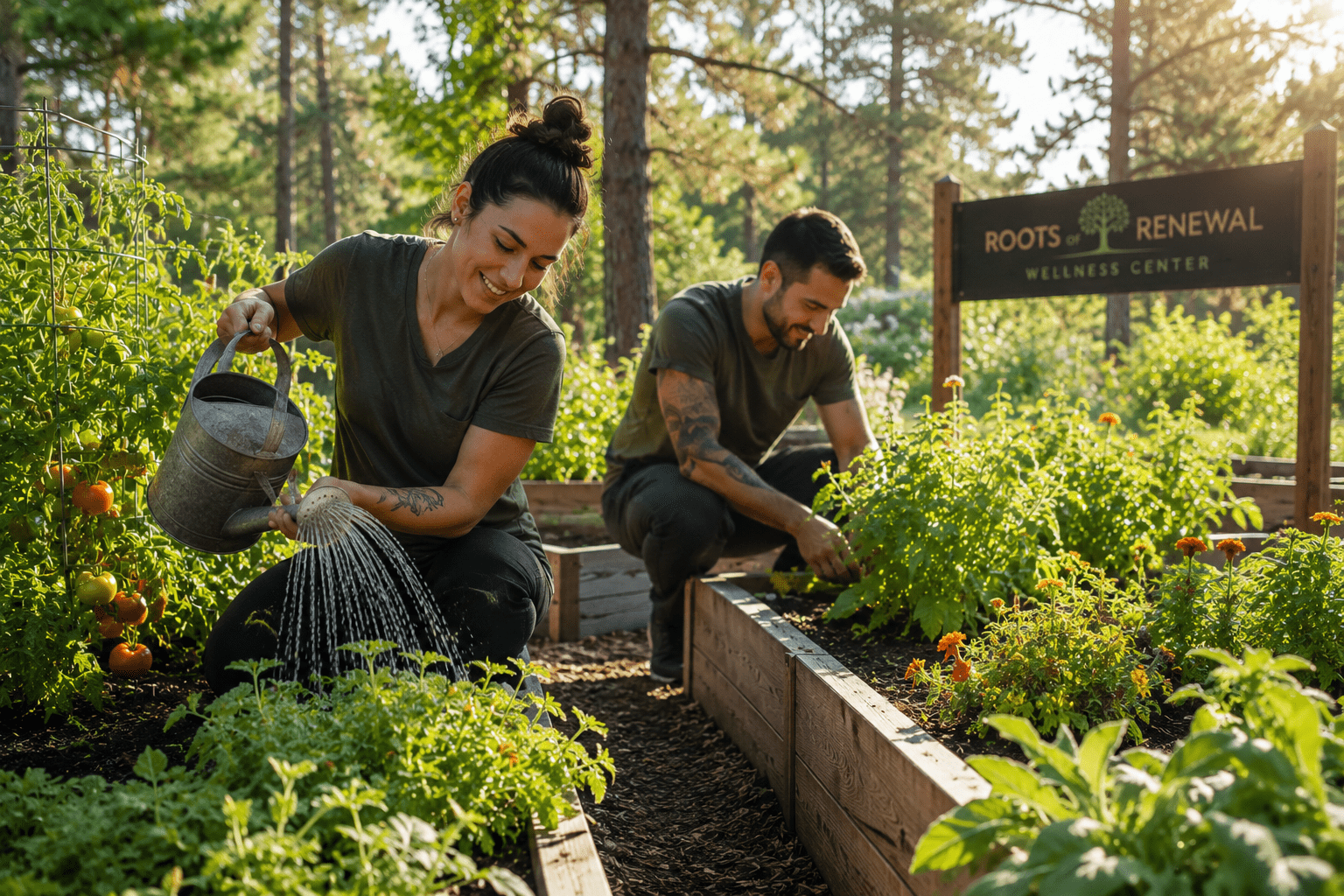
The first time someone hands you a tray of seedlings in rehab, it can feel like a joke. You came here to deal with a drinking problem, and now you’re being asked to water tomatoes. A man I’ll keep anonymous said exactly that his first week. Busywork, he called it. Something to fill the hours.
Three weeks later he was up before breakfast to check on those same tomatoes. Not because anyone made him. Because he wanted to see if the new growth had held overnight. It was the first thing in a long time he’d looked forward to.
Walk through enough treatment centers and you notice the pattern. There’s almost always a garden. Raised beds, a greenhouse, a few pots on a patio. It’s not there to look nice for the website. It’s doing real work.
What a garden actually does
A garden gives structure to a day that would otherwise feel shapeless. In early recovery, unstructured time is dangerous. It’s where cravings and spiraling thoughts move in. A plant needs water on a schedule, so the schedule gets built around something that isn’t you, which is oddly easier than doing it for yourself.
It also pulls you into the present. You can’t weed a bed while replaying last year’s worst night in your head. Your hands are busy, your eyes are on the soil, and for a little while the noise quiets down.
And it hands you responsibility you can actually meet. A lot of people arrive in treatment convinced they ruin everything they touch. Keeping a plant alive is a small, real argument against that story. You did that. It grew because you showed up.
Gardens run on the same rules as recovery
Nobody yells at a seed for not sprouting on day two. You put it in the ground, you water it, and you wait. The results come on their own schedule, not yours.
That’s a hard lesson for people used to the instant fix a substance provides. Recovery asks you to do the work now and trust that the payoff comes later, which is exactly what a garden demands. Some plants die no matter what you do. You pull them out and replant. You don’t quit the whole garden over one lost tomato.
Say all that out loud and it sounds like a greeting card. But you don’t experience it as a metaphor when you’re kneeling in the dirt. You just live it, and it sinks in sideways, which is often the only way real lessons land.
What the research says
This isn’t a soft idea with nothing behind it. There’s a growing body of evidence that working with plants helps mental health.
A 2025 systematic review and meta-analysis in Frontiers in Psychiatry looked at social and therapeutic horticulture, meaning gardening guided by a trained practitioner, and found it was linked to reduced symptoms of depression and anxiety. The authors were careful to note that the guidance matters, which is what separates real horticultural therapy from puttering around a flowerbed.
Earlier work points the same way. A 2017 meta-analysis in Preventive Medicine Reports pooled studies on gardening and found it was associated with lower depression and anxiety and a greater sense of life satisfaction and community. The dose doesn’t have to be huge. Regular time with your hands in the soil adds up.
Why it fits addiction recovery so well
Addiction rarely shows up by itself. According to SAMHSA’s 2024 National Survey on Drug Use and Health, about 46% of adults with a substance use disorder also had a mental illness that year, and depression and anxiety are near the top of that list.
A garden happens to push against both. It lifts mood, lowers stress, gives a shapeless day some structure, and asks nothing you have to be articulate to provide. For someone too raw or exhausted to sit through another talk session, an hour outside doing something with visible results can be the part of the day that actually helps.
That’s why it’s worth looking past the brochure when you’re choosing care. Ask what a program’s days actually look like beyond the clinical hours, whether there’s time outdoors and hands-on activity built into the routine. If you’re in Ohio, reaching out to an addiction and mental health treatment center near Columbus is a reasonable place to start that conversation.
When and how to get help
A garden is a good complement to treatment. It isn’t treatment by itself. If you or someone you love is leaning on alcohol or drugs to cope, the first step is a real assessment with a professional who can look at the whole situation.
You can start with your primary care doctor, call the behavioral health number on your insurance card, or contact a treatment center directly and ask how their program works day to day. There’s no wrong door. There’s just the one you actually walk through.
If you’re having thoughts of hurting yourself, call or text 988 in the U.S. It’s free and staffed around the clock.
Go back to the man and his tomatoes. Nobody would say a vegetable garden cured his addiction. But somewhere in those early mornings, he practiced showing up for something, waiting without rushing, and caring for a life that depended on him. Those are the exact muscles recovery needs, and it turns out you can grow them one plant at a time.
Sources
- Wood CJ, Barton J, Wicks CL (2025). Effectiveness of social and therapeutic horticulture for reducing symptoms of depression and anxiety: a systematic review and meta-analysis. Frontiers in Psychiatry — https://www.frontiersin.org/journals/psychiatry/articles/10.3389/fpsyt.2024.1507354/full
- Soga M, Gaston KJ, Yamaura Y (2017). Gardening is beneficial for health: A meta-analysis. Preventive Medicine Reports, 5, 92–99 — https://doi.org/10.1016/j.pmedr.2016.11.007
- Substance Abuse and Mental Health Services Administration (SAMHSA), 2024 National Survey on Drug Use and Health (co-occurring mental illness and substance use disorder) — https://www.samhsa.gov/blog/release-2024-nsduh-leveraging-latest-substance-use-mental-health-data-make-america-healthy-again